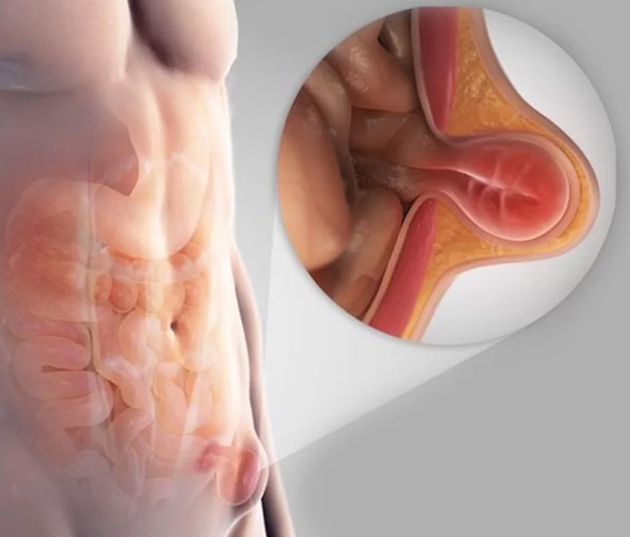
Inguinal, Umbilical, Incisional Hernia
A hernia occurs when an internal organ or tissue pushes through a weakened area in the surrounding muscle or connective tissue. Hernias commonly develop in the groin, around the umbilicus or at the site of a previous abdominal incision.
Although some hernias may remain small and cause minimal symptoms, they can gradually increase in size and may become painful or complicated by obstruction or loss of blood supply to the trapped tissue. Surgical repair is the definitive treatment for symptomatic or complicated hernias.
Conditions
Different types of abdominal wall hernias can occur depending on their location and underlying cause. Common presentations include:
- Inguinal hernia
- Direct or indirect inguinal hernia
- Umbilical hernia
- Paraumbilical hernia
- Incisional hernia following previous abdominal surgery
- Recurrent hernia
- Reducible or irreducible hernia
- Incarcerated or strangulated hernia
The size, location, symptoms and presence of complications are important factors when deciding whether surgical repair is required and which technique is most appropriate.
Symptoms
Some hernias may not cause symptoms initially. When symptoms develop, patients may experience:
- A visible or palpable bulge in the groin, abdomen or umbilical region
- Pain or discomfort at the site of the hernia
- Pain that increases with coughing, lifting or physical activity
- A feeling of heaviness or pressure
- Increasing size of the abdominal wall swelling
- Difficulty reducing the hernia swelling
- Nausea and vomiting in cases of bowel obstruction
- Severe pain and tenderness in cases of strangulation
A hernia that suddenly becomes painful, firm or cannot be pushed back inside, particularly when associated with vomiting or abdominal distension, requires urgent medical evaluation.
Causes
Hernias develop when there is a weakness in the abdominal wall combined with increased pressure inside the abdomen. Several factors may contribute to their development.
- Weakness in the abdominal wall
- Previous abdominal surgery causing an incisional hernia
- Repeated heavy lifting or physical strain
- Chronic cough
- Chronic constipation and straining during bowel movements
- Obesity or increased abdominal pressure
- Pregnancy
- Family history or inherited weakness of connective tissue
- Increasing age
Incisional hernias specifically develop through a weakened area of a previous surgical incision and may appear months or years after abdominal surgery.
Treatment
Treatment depends on the type, size and symptoms of the hernia, the patient's general health and whether complications are present. Clinical examination and, in selected cases, ultrasound or CT imaging may be used to assess the hernia.
Treatment options may include:
- Observation for selected small and minimally symptomatic hernias
- Open hernia repair
- Laparoscopic hernia repair
- Robotic-assisted hernia repair in selected patients
- Mesh-based repair for appropriate abdominal wall defects
- Abdominal wall reconstruction for complex or large incisional hernias
- Emergency surgery for incarcerated or strangulated hernias
- Repair of recurrent hernias using an individualized surgical approach
Surgical repair is generally recommended for symptomatic, enlarging or complicated hernias. The choice between open, laparoscopic and robotic techniques depends on the type and size of the hernia, previous operations, abdominal wall anatomy and the patient's overall condition.
The goal of hernia surgery is to safely return the protruding tissue to the abdominal cavity and reinforce the weakened abdominal wall while reducing the risk of recurrence.
Prevention
Not all hernias can be prevented, particularly those related to natural weaknesses in the abdominal wall. However, certain measures may help reduce the risk of developing or worsening a hernia.
- Maintain a healthy body weight.
- Avoid unnecessary heavy lifting and use proper lifting techniques.
- Manage chronic cough and respiratory conditions appropriately.
- Prevent and treat chronic constipation.
- Follow appropriate postoperative wound-care instructions after abdominal surgery.
- Gradually return to physical activity after abdominal surgery as advised by your surgeon.
- Seek medical evaluation for a new or enlarging abdominal or groin swelling.
Early evaluation and appropriate surgical management can help prevent complications such as incarceration, bowel obstruction and strangulation.